 Postry
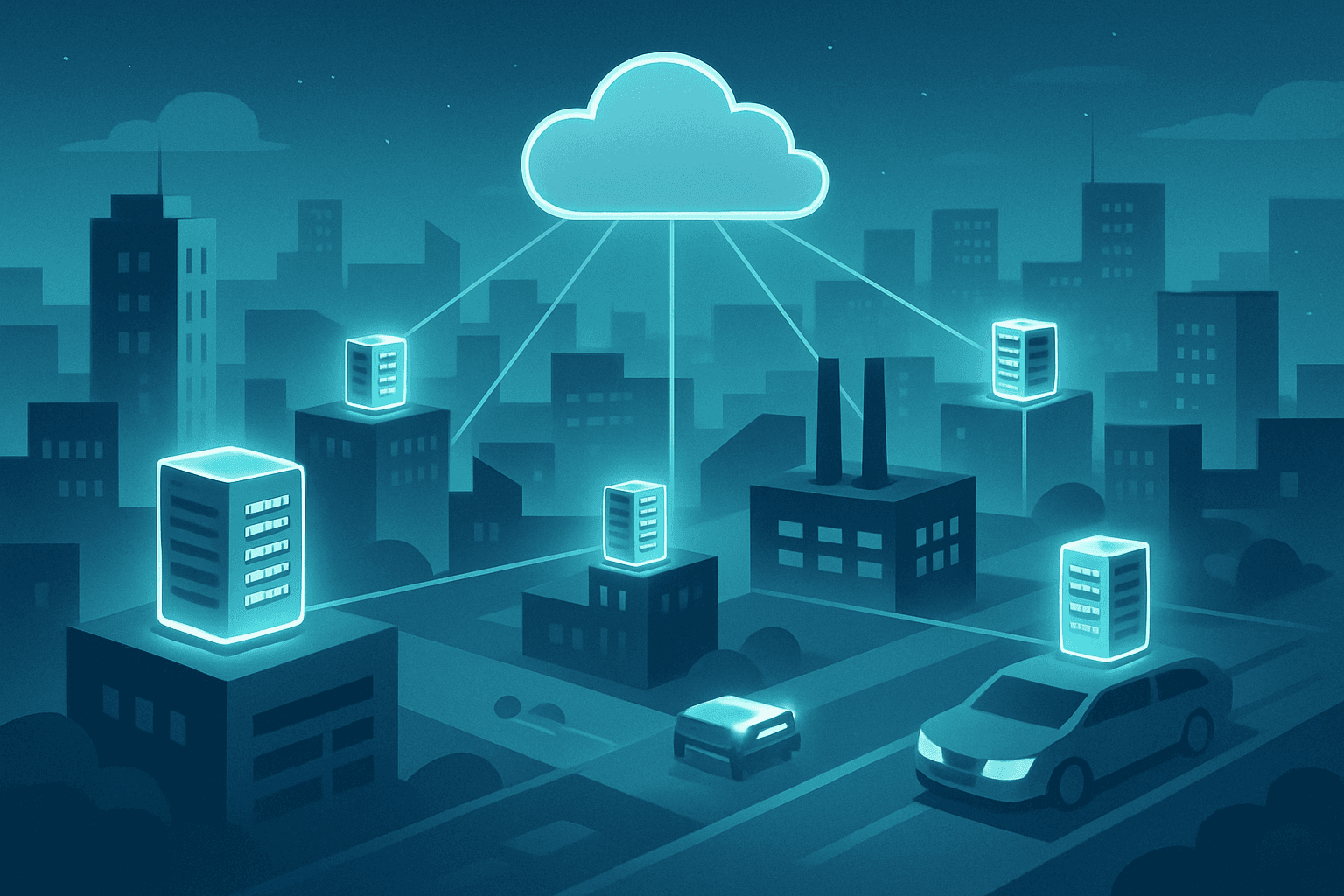
If you work with software development or infrastructure, you've probably heard about edge computing. But between the hype and reality, there's a massive gap. Most articles explain the concept superficially and fail to answer the question that actually matters: when does it make sense to use edge computing in your project, and when is it a waste of money?
In this guide, I'll explain what edge computing really is, how the architecture works in practice, what the legitimate use cases are in 2026 and — just as importantly — when you should simply stick with centralized cloud. All with concrete examples and verifiable sources.
I've been working with distributed systems architecture for several years and have implemented edge computing solutions in two distinct projects: an industrial monitoring system with IoT sensors and a real-time video processing application for retail. The most important lesson I learned is that edge computing is not a silver bullet — it's a specific tool for specific problems. In both projects, the decision to use edge was only justified after proving, with numbers, that centralized cloud latency was the actual bottleneck. Without that proof, it would have been expensive overengineering.
What is Edge Computing: a technical definition without the fluff
Edge computing is a distributed computing architecture where data processing happens close to the source, rather than being sent to a centralized data center or public cloud. The "edge" refers to the extremity of the network — where devices, sensors, and end users interact with the infrastructure, as defined by Microsoft Azure's documentation.
In practice, this means placing processing capacity — smaller servers, intelligent gateways, specialized devices — physically close to where data is generated. Instead of sending every byte to AWS in Virginia, you process locally and send only the aggregated result.
The fundamental difference between edge and cloud isn't binary — it's a spectrum. There's the device edge (processing on the device itself, like a smartphone or sensor), the near edge (a local server in the factory or store), and the far edge (a regional data center closer to the user, like CDN points of presence). Each layer offers different trade-offs between latency, processing capacity, and cost.
How edge computing architecture works
A typical edge computing architecture has three layers that work together:
Device Layer
This is where data is born. IoT sensors, cameras, connected vehicles, mobile devices. At this layer, processing capacity is limited but sufficient for basic filtering and preprocessing. A temperature sensor, for example, can discard redundant readings before transmitting.
Edge Layer
This is where the real value lives. Local servers, industrial gateways, or micro data centers positioned strategically. This layer runs AI model inference, data aggregation, real-time anomaly detection, and decisions that can't wait for the round trip to the cloud. A gateway in a factory, for example, receives data from hundreds of sensors, identifies anomalous patterns, and triggers alerts in milliseconds.
Cloud Layer
The cloud remains essential — but its role changes. Instead of processing raw data in real time, it manages machine learning model training, stores historical data for long-term analytics, coordinates software updates across edge nodes, and provides centralized dashboards. According to IBM, this separation of responsibilities drastically reduces network traffic and bandwidth costs.
| Characteristic | Edge Computing | Cloud Computing |
|---|---|---|
| Latency | 1-10 ms | 50-200 ms |
| Required bandwidth | Low (data processed locally) | High (raw data transmitted) |
| Offline availability | Yes — operates without internet | No — depends on connectivity |
| Processing capacity | Limited to local hardware | Virtually unlimited |
| Initial cost | Higher (distributed hardware) | Lower (pay-as-you-go) |
| Maintenance | Complex (distributed nodes) | Managed by provider |
| Data security | Data stays local | Data transits the network |
When to use edge computing: the 5 decisive criteria
After analyzing dozens of real implementations and documented cases by providers like Claranet and Microsoft, I've identified five criteria that, when combined, justify edge computing. If your project meets two or more, it's worth serious investigation.
1. Latency is a functional requirement, not just desirable
If your application needs responses in under 20ms to function correctly, centralized cloud probably won't cut it. Real examples: industrial robot control, autonomous vehicles, security systems with real-time intrusion detection, games with physical interaction (AR/VR). In these cases, every millisecond of round-trip to the cloud can mean a collision, a production defect, or an unacceptable user experience.
2. Data volume generated is disproportionate to what needs to be stored
A 4K surveillance camera generates approximately 15 GB per day. A hundred cameras generate 1.5 TB. Transmitting all of this to the cloud is impractical and expensive. With edge, you process video locally, extract only relevant events (motion detected, person identified, anomaly), and send only metadata and relevant clips. Traffic reduction can reach 95%.
3. Connectivity is unstable or nonexistent
Oil platforms, underground mines, remote farms, ships — any environment where internet is intermittent needs local processing. Edge computing ensures the system continues operating offline, syncing data when connectivity returns. This is one of the clearest and least debatable cases.
4. Regulation requires local data
Brazil's LGPD, Europe's GDPR, and similar legislation in various countries require that certain personal data be processed within specific jurisdictions. Edge computing allows processing sensitive data locally without it crossing geographic borders, significantly simplifying compliance.
5. Cloud costs have scaled unsustainably
When data volume grows, the cloud bill grows with it — bandwidth, processing, storage. In certain scenarios, implementing edge computing reduces long-term operational costs, even with the higher initial hardware investment. According to market analysis published by Cloudwards, companies processing large volumes of IoT data save between 30% and 60% on cloud costs after migrating primary processing to edge.
When NOT to use edge computing
Knowing when not to use edge computing is just as important as knowing when to use it. These are the scenarios where centralized cloud remains the correct choice:
- Traditional web applications — if your application is a SaaS, e-commerce, or REST API serving users via browser, the 50-100ms cloud latency is perfectly acceptable. Adding edge would be unnecessary complexity.
- Batch processing — historical data analysis, ML model training, report generation. None of this requires real-time; cloud is more efficient and scalable for batch workloads.
- Low data volume — if your devices generate kilobytes per minute, not gigabytes per second, transmission costs are negligible. Edge doesn't justify itself economically.
- Small team without distributed systems experience — edge computing adds significant operational complexity. If your team already struggles to maintain a simple cloud infrastructure, adding distributed edge nodes will multiply problems.
- Proof of concept or MVP — in early stages, optimize for development speed, not latency. Start in the cloud, measure, and migrate to edge only when data proves the need.
Real use cases in 2026
The edge computing market has matured significantly in recent years. According to Logic Fruit Technologies, the dominant trend in 2026 is hybrid architecture — edge and cloud working together, each doing what it does best. Here are the most relevant cases:
Smart manufacturing and Industry 4.0
Modern factories operate with thousands of sensors monitoring temperature, vibration, pressure, and product quality. Edge processing enables real-time predictive maintenance — detecting that a machine will fail before it happens, avoiding unplanned downtime that costs thousands of dollars per hour. Companies like Siemens and Bosch already operate with edge gateways on their production lines, processing data locally and sending only alerts and aggregated metrics to the cloud.
Smart retail
Retail chains use edge computing for in-store video processing — people counting, flow analysis, loss prevention, and cashierless checkout. Processing needs to be local because transmitting video from hundreds of cameras to the cloud is unfeasible in terms of cost and latency. Amazon with its Amazon Go stores pioneered this, but in 2026 smaller chains already implement similar solutions with accessible hardware.
Autonomous vehicles and transportation
An autonomous vehicle generates about 20 TB of data per day between cameras, LiDAR, radar, and sensors. Processing this data in the cloud is physically impossible — the decision to brake needs to happen in milliseconds, not hundreds of milliseconds. All critical driving processing happens at the edge (the vehicle's own computer), while telemetry and training data are sent to the cloud in batches.
Healthcare and medical devices
Remote patient monitoring devices — such as cardiac monitors, continuous glucose meters, and pulse oximeters — process data on the device itself or on hospital gateways. Beyond latency (detecting an arrhythmia needs to be instantaneous), health regulations require patient data to be processed in controlled and certified environments.
Telecommunications and 5G
5G and edge computing are complementary technologies. Carriers are positioning computing capacity at their towers and base stations, creating an edge layer that third-party applications can leverage. This enables cases like real-time augmented reality, cloud gaming with sub-10ms latency, and vehicle-to-vehicle (V2V) communication.
Tools and platforms to get started
If you've decided that edge computing makes sense for your case, these are the main platforms available in 2026:
- AWS IoT Greengrass — allows running Lambda functions and Docker containers on edge devices, with automatic synchronization with the AWS cloud.
- Azure IoT Edge — deploy containerized modules on edge devices, integrated with Azure IoT Hub for centralized management.
- Google Distributed Cloud Edge — extension of Google Cloud for on-premises and edge locations, with Kubernetes support.
- K3s — lightweight Kubernetes distribution designed for edge and IoT, maintained by SUSE/Rancher. Runs with less than 512 MB of RAM.
- EdgeX Foundry — open-source framework from the Linux Foundation specifically for IoT edge, with a pluggable microservices architecture.
The choice depends on your existing ecosystem. If you're already on AWS, Greengrass is the natural path. If you need vendor independence, K3s with EdgeX Foundry offers maximum flexibility.
Edge Computing and AI: the combination that's accelerating
One of the most significant developments of 2026 is the convergence of edge computing and artificial intelligence. Optimized AI models — quantized, distilled, and compiled for specific hardware — now run on devices with modest GPUs or even on NPUs (Neural Processing Units) integrated into ARM chips.
This enables computer vision model inference, natural language processing, and anomaly detection directly at the edge, without needing cloud connectivity. Training continues to be done in the cloud (where computational power is virtually unlimited), but inference — which is what matters in production — migrates to the edge.
Frameworks like TensorFlow Lite, ONNX Runtime, and PyTorch Mobile have made this transition more accessible, and hardware like NVIDIA Jetson, Google Coral, and Intel Neural Compute Stick offer AI processing capacity in compact and energy-efficient form factors.
Conclusion
Edge computing is not the future of computing — it's a piece of the puzzle. The ideal architecture in 2026 is hybrid: edge processes what needs to be fast, local, and efficient; cloud manages what needs scale, long-term storage, and massive computational power. The decision to use edge should be guided by concrete data — measured latency, calculated data volume, projected costs — and not by hype or vendor pressure. If you meet two or more of the five criteria I discussed in this article, edge computing probably makes sense for your project. If you don't, stick with cloud and don't feel behind for it. The best architecture is the one that solves the real problem with the least complexity possible.
